

About This Image
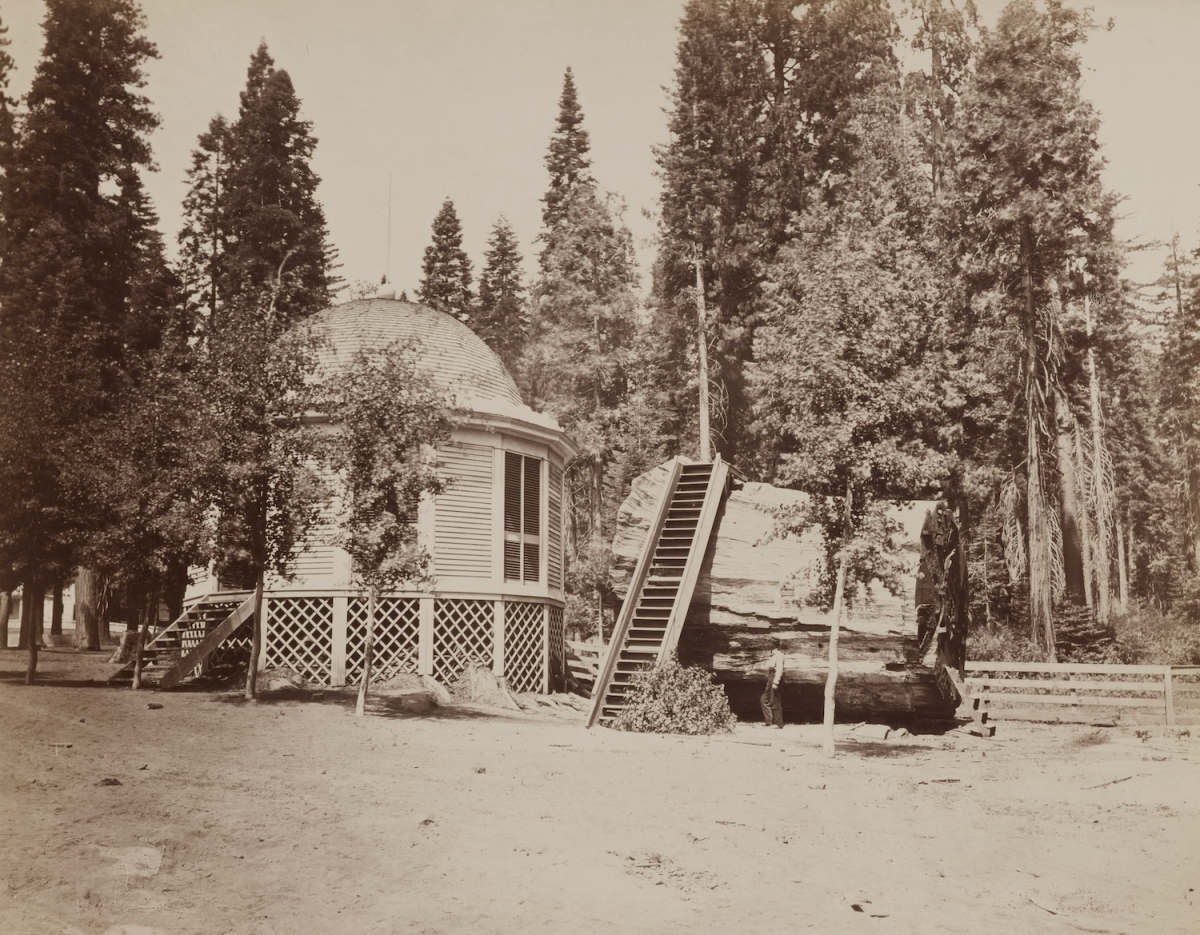
Title and publisher (Thomas Houseworth & Co., 1872) on label on mount. The number "29" is in pencil at the bottom right of the mount. The number and title matches the information on the Weed album of mammoth plates that sold at Sotheby's Photographs, Lot 25, October 3, 2012.
The matching image of this print from that Sotheby's album can be found at: https://commons.wikimedia.org/wiki/File:The_Original_Big_Tree_by_Charles_L_Weed,_1864.jpg#/media/File:The_Original_Big_Tree_by_Charles_L_Weed,_1864.jpg.
Provenance: François Lepage Collection.
Charles Leander Weed (1824-1903) was an influential American photographer renowned for his documentation of the American West during the mid-19th century.
Born in New York, Weed began his career as a portrait painter, but his interest soon shifted towards photography, a burgeoning medium at the time. Weed’s early work primarily focused on portraiture, but he soon ventured into landscape photography, inspired by the vast and untamed beauty of the American West.
In 1859, Weed embarked on a significant journey across the western United States, armed with his camera and a vision to document the changing landscapes and cultures of the region. His photographs, often utilizing albumen prints and stereographs, are considered among the earliest and most comprehensive records of the American West during this transformative period.
Born in New York State, Weed moved first to Wisconsin with his family and then to California, where he was associated with the daguerreotypist George W. Watson in Sacramento and then with Robert Vance. It was while he worked for Vance that Weed learned the wet-plate process, and his 1859 Yosemite photographs were made with this new method.
In 1860, Weed made his first Asia trip, photographing and setting up studios in Hong Kong and Canton. By 1864, when he had returned to San Francisco, partnered with Lawrence & Houseworth, and made his second foray into Yosemite Valley, he was a more skilled and experienced photographer.
Throughout his career, Weed's work was widely acclaimed for its artistic merit and historical significance. His images, which highlighted the juxtaposition of nature and civilization, continue to inspire and resonate today. Charles Leander Weed's legacy as a pioneering figure in American photography remains enduring, reflecting his commitment to capturing the essence of the American West.
One of 30 mammoth-plate albumen prints of Yosemite Valley, Mariposa County, and the Big Trees, Calaveras County, California taken in 1864 by Charles Leander Weed and published by Lawrence & Houseworth.
Weed is widely believed to have been the first photographer to work in Yosemite. For his 1864 photographic expedition to the Valley, Weed was equipped with a large camera and large glass plates, enabling him to produce these mammoth-plate prints which won the first-place bronze medal at the 1867 Paris International Exhibition for their superior excellence.
Most U.S. domestic Fed Ex ground shipping (Media Mail for books) will be a flat $25 charge except for larger and heavier items, or unless the buyer wants express shipping (email us your requests for the latter). International shipping and insurance costs will be added to the price and must be paid for by the buyer. Pennsylvania buyers must pay appropriate local sales tax. International clients are responsible for their local customs duties and taxes, which will be charged by Fed Ex, which will contact the client prior to delivery.
Price $18,000
Ref.# 16611
Medium Albumen print from wet plate negative
Mount on original mount
Photo Date 1864 Print Date 1872
Dimensions 15-5/8 x 20-1/4 in. (398 x 515 mm)
Photo Country United States (USA)
Photographer Country United States (USA)
Contact
Email info@vintageworks.net
Phone +1-215-518-6962
Company
Contemporary Works / Vintage Works, Ltd.


Share This