

Interview: Nederlands Fotomuseum with Martijn van den Broek and Grace Wong-Si-Kwie
Contemporary Works/Vintage Works Holiday Sale Ends Soon. Don't Miss It!
Julie Jones Has Been Appointed the New Director of the MEP
Bonhams Opens New Flagship Auction House in NYC
PhotoResearcher No. 44: The Autochrome in Imperial History
Former Director of the GEH and CCP James Enyeart Passed Away
PhotoResearcher is the bi-annual journal of The European Society for the History of Photography (ESPHPh). The society is based in Vienna and was established in 1978 with the aim of researching the historical development of photography from its origins up to the present and integrate that into a worldwide context. From the very beginning, the Society saw itself as an open platform on interdisciplinary photographic research without any geographical borders. That appealed to many of the leading curators from the main museums of the period, as well as parties from the most varied spheres with an interest in photography.
The society has organized numerous conferences, symposia and exhibitions over the years and PhotoResearcher, launched in 1990, acts as its mouthpiece. Each issue brings together contributions from researchers and specialists, most often focusing on less well-known aspects of photography which makes for fascinating reading and each issue has a theme, such as 36, focused on private photo collecting and issue 41, entitled The Darkroom – Chemical, Cultural, Industrial.
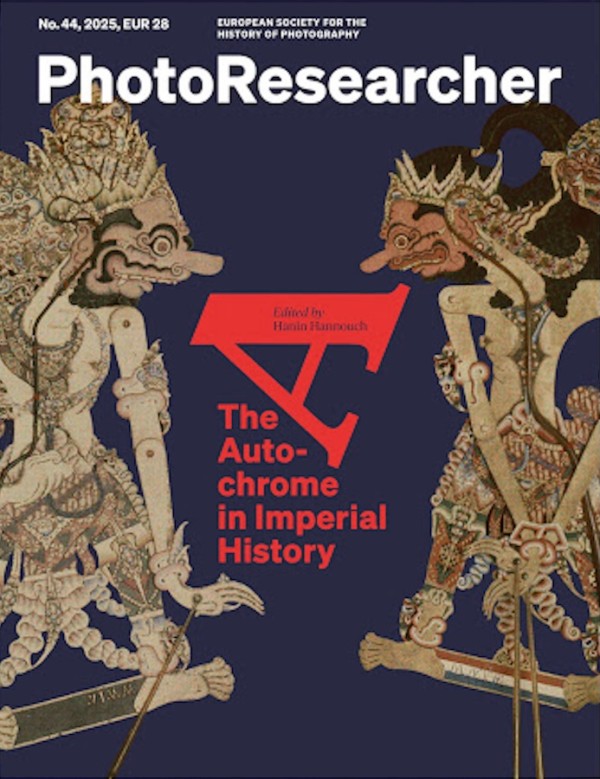
The latest issue, No. 44, is entitled The Autochrome in Imperial History and it deals with the role of the Lumière brothers' Autochrome in global colonial and political contexts. The idea was inspired by the Tassilo Adam Collection, housed at Weltumuseum in Vienna. Adam, a plantation manager and photographer in the Dutch East Indies, who gifted the collection, including his Autochromes, to the museum in 1940; and a group of the Autochromes show the lavish estate of Karl Bosscha in Java, Indonesia.
Historically, the "Autochrome" refers to both the photographic process; meaning the various and unique steps needed for the technical genesis of the image, as well as the branded product "Autochrome", referring to the plates sold on the market by the Lumière company. 'Auto' refers to spontaneous, independent and 'Chrome', a derivative of the noun 'chroma', refers to color. The process was patented on December 17, 1903, by Auguste and Louis Lumière, who refined its manufacturing until it was marketed to the general public on June 10, 1907. As one of the first commercially successful color photographic technologies, the Autochrome had an international reach, disseminated through global trade, diplomacy, and imperialism.
Editor Hanin Hannouch notes that "this volume distinguishes itself from prior scholarship on the Autochrome by prioritizing the medium's political deployment over poetic or aesthetic interpretations", and it does so in series of captivating case studies. Hannouch deals with the aforementioned Tassilo Adam Autchromes.
Janine Freeston investigates the Autochomes taken by British amateur Pictorialists at the Franco-British Exhibition, held in London in 1908. These latter Autochromes are part of the Royal Photography Society Collection, which are kept at the Victoria & Albert Museum. The exhibition was held as a way of celebrating the Entente Cordiale, the agreement entered into by France and Britain in 1904 to resolve a series of expensive territorial disputes and strengthening their international power and influence.
Rachel Lee Hutchinson shines light on the little-known American Autochromist Fred Payne Clatworthy (1875 – 1953), a commercial photographer based in Estes Park in the Rocky Mountains, who used the Autochrome well into the 1920s, and whose images, as the author notes, "demonstrated a shift in the conception of the American West, one that emphasized its accessibility and tourist potential for a greater number of audiences."
These essays shine a light not only on the political aspects of these quite frankly gorgeous Autochromes, but also on territories whose photographic history has largely been overlooked. That includes Inga Lára Baldvinsdóttir's essay on Auchromes taken in Iceland in the 1910s and 1920s, when Iceland was still part of the Kingdom of Denmark. It's also true for the Autochromes taken in Slovakia in the 1910s, then part of the Austro-Hungarian Empire, researched by Kitti Baráthova, Katarina Benová and Janka Blasko Krizanova. Autochromes of the Russian Empire are dealt with by Nadezhda Stanulevich.
PhotoResearcher can be ordered from http://www.eshph.org.
Michael Diemar is editor-in-chief of The Classic, a print and digital magazine about classic photography. In August 2025, he cofounded Vintage Photo Fairs Europe, an organization focused on promoting independent tabletop fairs in Europe and spreading knowledge about classic photography in general. He is a long-time writer about the photography scene, writing extensively for several Scandinavian photography publications, as well as for the E-Photo Newsletter and I Photo Central.
Interview: Nederlands Fotomuseum with Martijn van den Broek and Grace Wong-Si-Kwie
Contemporary Works/Vintage Works Holiday Sale Ends Soon. Don't Miss It!
Julie Jones Has Been Appointed the New Director of the MEP
Bonhams Opens New Flagship Auction House in NYC
PhotoResearcher No. 44: The Autochrome in Imperial History
Former Director of the GEH and CCP James Enyeart Passed Away


Share This