

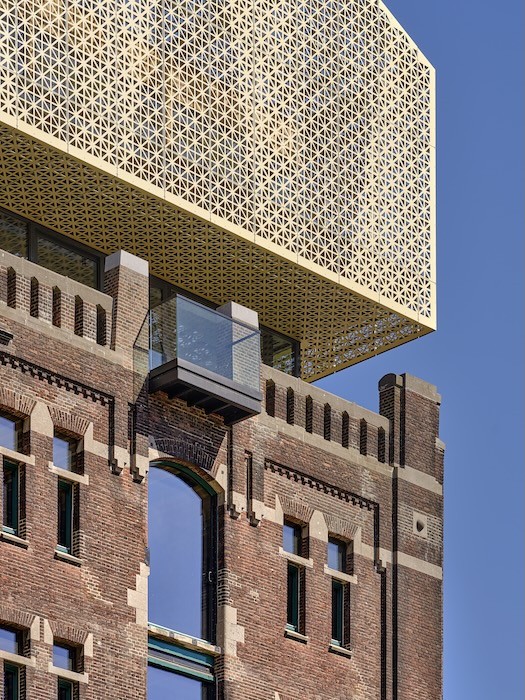
Nederlands Fotomuseum, exterior view. © Foto Studio Hans Wilschut.
On February 7, Nederlands Fotomuseum, the National Museum of Photography in the Netherlands, reopened in its new location; the historic Santos warehouse, Rotterdam, providing a state-of-the-art home for the collection of more than 6.5 million objects.
The new museum houses the Gallery of Honor of Dutch Photography, temporary exhibitions and educational spaces. It also has a library with the largest collection of photo books in Europe, a darkroom, open studio spaces, a café and a restaurant with a panoramic view of the Rotterdam skyline.
The Gallery of Honor shows the development of photography in the Netherlands, from the launch of the medium in 1839 to today. On display are 99 photographs that have been chosen for their social and artistic impact and include masterpieces by Anton Corbijn, Dana Lixenberg, Violette Cornelius, Ed van der Elsken, Paul Huf, Rineke Dijkstra and Erwin Olaf. The 100th work in the exhibition will be chosen by visitors.
There are two temporary opening exhibitions.
The first one, 'Rotterdam in Focus', is an overview of photography of the city from 1843 to the present day. They were taken by both professional and amateur photographers. Iconic photographers such as Hans Aarsman, Iwan Baan, Eva Besnyö, Henri Berssenbrugge, Johann Georg Hameter, Helena van der Kraan, Jannes Linders, Cas Oorthuys, Otto Snoek and others show how a changing Rotterdam constantly challenges the viewer to find new ways of looking, observing, and photographing. The exhibition includes work from leading collections, including those of the Nederlands Fotomuseum, the Stadsarchief Rotterdam, the Dutch Royal Collections, and the Maria Austria Institute.
The second exhibition, 'Awakening in Blue: An Ode to Cyanotype' celebrates the timeless beauty of one of the oldest and most recognizable photographic techniques: Cyanotype. In addition to rare, early blueprints, the exhibition features work by 15 contemporary artists. They breathe new life into this 19th-century technique, combining it with new media and a variety of materials. Their work explores current themes such as ecology, colonialism and the body as a living archive. The exhibition is designed by MAISON the FAUX, a Dutch interdisciplinary collective known for their groundbreaking work at the intersection of fashion, performance and installation art.
Before speaking to Martijn van den Broek, Head of Collections, I asked Grace Wong-Si-Kwie, Head of Presentation and Public, about the exhibition program and its aims.
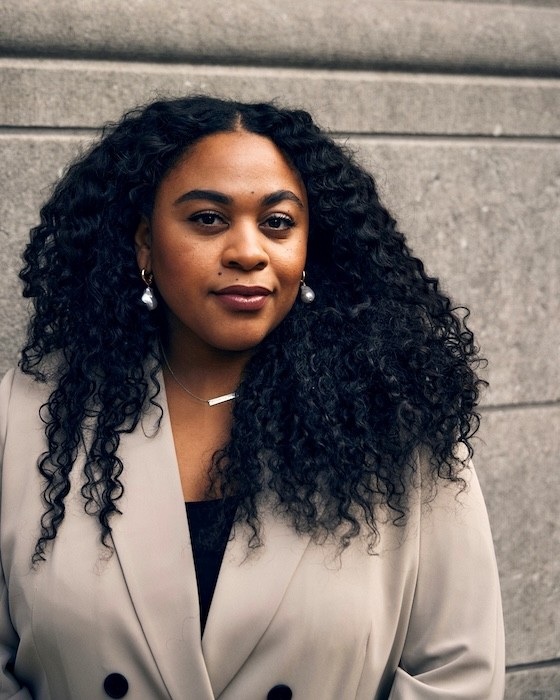
Grace Wong-Si-Kwie. Credit Konrad Sachadel.
"It focuses on actively contributing to the perception of photography. We not only present current social themes, but also highlight topics and perspectives less visible to the general public. We see it as our mission to introduce diverse perspectives, and invite visitors to learn to see and read photography anew. We approach photography across its full breadth and depth: from solo presentations to group exhibitions, always with an eye for current events within the photographic field. With this program, the museum emphatically positions itself as a pioneer: a place where the current photographic landscape becomes visible. The 4th floor is for vintage photography; the 5th floor for young talent."
Issues of inclusivity and offering different perspectives have become more important in the museum sector. How about your museum?
"The museum has a diversity and inclusion working group developing ideas on this topic. These include practical matters such as accessibility, for example, for people with physical disabilities, but also the readability of texts. The museum is also a member of the organization, Accessible Museum (Toegankelijk Museum). It helps museums develop programs for different groups of people."
And so to Martijn van den Broek. He has been Head of Collections since 2008. Nederlands Fotomuseum has moved a few times since it was founded in 2003. In 2007, it moved to Wilhelminakade. The museum was impressive, so I asked van den Broek what prompted yet another move, this time to the Santos warehouse.
"There were two main reasons why the Nederlands Fotomuseum wanted to move. We were being held back by our previous location, which prevented us from being able to truly make an impact on the city of Rotterdam, and to fully realize our ambition to become a state-of-the-art photography center and the embodiment of the Dutch reputation for excellence in photography.
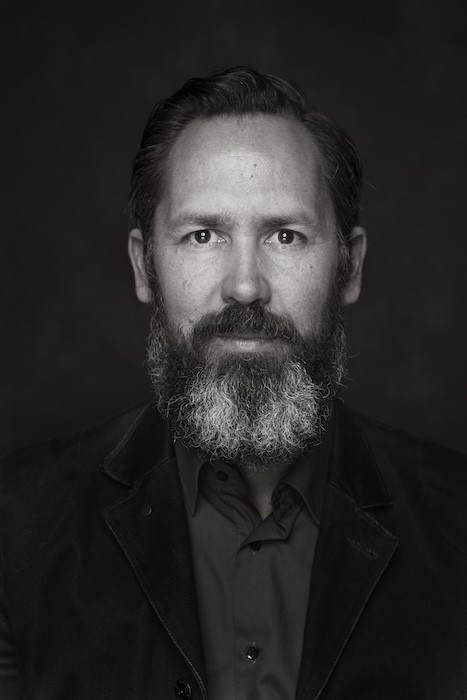
Martin van Broek. Credit Susanne Middelberg.
"The museum was housed in a multi-tenant building, so it lacked a distinct identity. Moreover, the museum rented the space, and the rent was becoming increasingly expensive. When the opportunity arose to acquire the magnificent Grade A Santos warehouse, we simply jumped at the chance. The impact of this building is not only architectural, but also historical: the story of this warehouse is fundamental to the history of Rotterdam. Keeping it alive and filling it with the creative life of the city is a major goal for us. The acquisition of the new building fulfills our longstanding commitment to developing a dynamic meeting place that is open to all and an international platform for Dutch photography. It has been made possible by a generous donation from the Droom en Daad Foundation. And thanks to the purchase, the rental costs have been eliminated. In short, the opening in the Santos warehouse heralds a new chapter for the most important center for photography in the Netherlands."
When were the first plans for the new museum drawn up?
"Droom en Daad Foundation knew about our search for a new home. When they learned that Stilwerk, the German design department store group that owned the Santos warehouse, was putting it up for sale, the ball started rolling. We were extremely fortunate that the warehouse building, which had been recently restored and expanded by Stilwerk, was so well suited to the requirements of our future home.
"We acquired the building in 2023 and in early 2024 construction was completed on the shell and core. The work on readapting the spaces for our purposes started in the summer of 2024. The building needed to be adapted for museum use and there was a lot to do. A museum building needs--among other things--a climate control system for a suitable indoor climate, a storage facility to properly preserve the works, and proper lighting control. The restoration and expansion were carried out by the architectural team Renner Hainke Wirth Zirn Architekten, Hamburg and Wdjarchitecten, Rotterdam. And then, in October 2025, we began moving the collection to our new home."
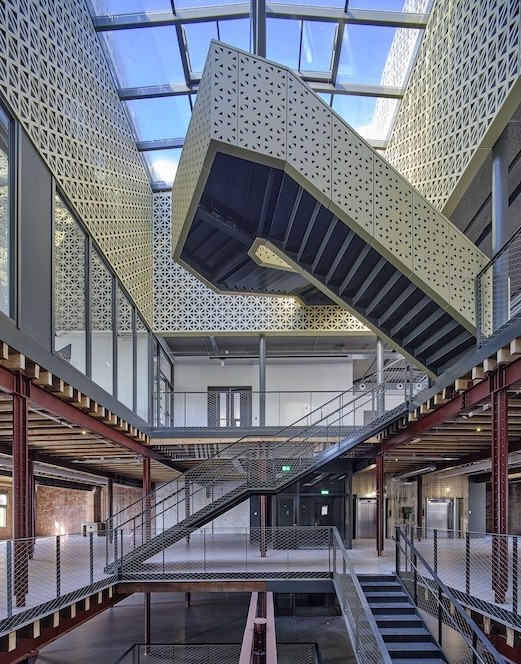
Nederlands Fotomuseum, interior view. © Foto Studio Hans Wilschut
Can you give me an overview of the museum and the facilities?
"The building has nine stories and it's one of the best-preserved historic warehouses in the country. Visitors will not only have access to masterpieces from the national collection, but also be given a unique behind-the-scenes glimpse of the work that is carried out in the open storage rooms and restoration ateliers. The new museum houses the Gallery of Honor of Dutch Photography, temporary exhibitions and educational spaces. It also has a library with one of the largest collections of photo books in Europe, a darkroom, a café and a restaurant with a panoramic view of the Rotterdam skyline. On the ground floor, we have created a kind living room for photography, an inviting meeting place with a café, library, museum shop and reception desk. Visitors are welcome here, even without a ticket, to meet each other, have a drink, read, and watch the short film that Marwan Magroun, who was made 'Photographer of the Netherlands' in 2024, made especially for the reopening of the museum."
It's a very "open" museum, with glass walls, enabling visitors to see the various specialists at work, echoing, incidentally, the concept at the Victoria & Albert Museum's East Storehouse. Was that part of the concept from the beginning?
"It was. In our former home, the Las Palmas building, the enormous collection and inner workings of the museum were almost invisible. The layout of the Santos warehouse allowed us to bring the collection and the work behind the scenes more to life. The collection and the conservation workshops are located in the heart of the building and spread over two floors. Glass walls allow visitors to take a look behind the scenes: the open depots display a selection from the collection, together with special and remarkable objects from the collection, while the visitor can also see specialists at work on conservation in the open ateliers."
Nederlands Fotomuseum was founded in 2003, and it grew out of three institutions. You used to work at Nederlands Fotoarchief. Can you tell me about those institutions?
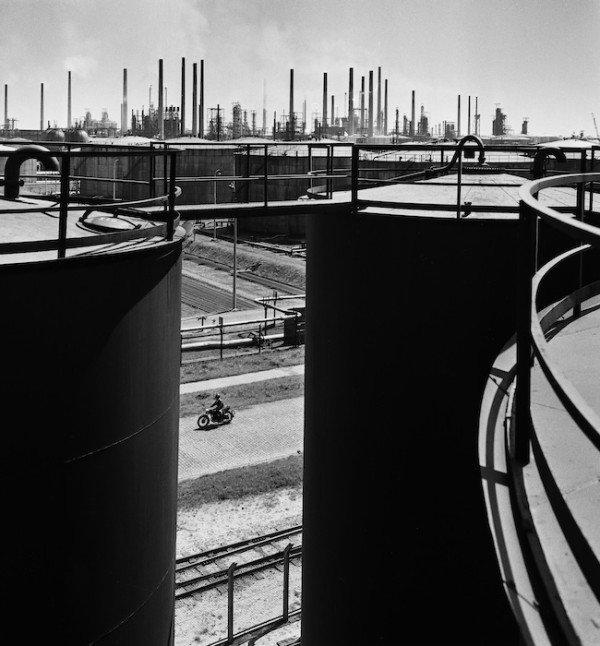
Cas Oorthuys, Vondelingenweg, 1957- 1958, Nederlands Fotomuseum. © Cas Oorthuys/Nederlands Fotomuseum. The image is part of the 'Rotterdam in Focus' , which is an overview of photography of the city from 1843 to the present day in a temporary exhibit up through May 24th at the museum.
"Nederlands Foto-instituut (NFI) was primarily a presentation institution with a very good library, and they also published books. Nederlands Fotoarchief (nfa), focused on collecting and preserving Dutch photographers' archives, with historical photography related to the Netherlands. It was an idea brought forward by the photographers themselves. Nationaal Fohotorestauratie Atelier (NFrA), was the national photographic conservation studio and was specialized in conserving and restoring photographic objects, ensuring long-term preservation of photographic heritage.
"Nederlands Fotomuseum, the National Museum of Photography, was established in 2003 in Rotterdam, primarily thanks to a generous bequest from Hein Wertheimer, a passionate amateur photographer who left 22 million Guilders (11.2 million Euros) to establish a museum for Dutch photography. Its creation marked the formal merger of three pre-existing Dutch photographic institutions into one national museum for photography.
"The three organizations were brought together under one institutional umbrella, combining their collections, expertise, and missions. This integration allowed for a more unified approach to maintaining, studying, and presenting Dutch photographic heritage. After its foundation in 2003, the museum opened to the public and has since grown into a major center for photographic art and history, safeguarding a collection with archives consisting of millions of prints, slides and negatives, while organizing exhibitions and educational programs connected to both historical and contemporary photography. The Nederlands Fotomuseum is one of 30 national museums in the Netherlands."
Can you tell me about the museum collection?
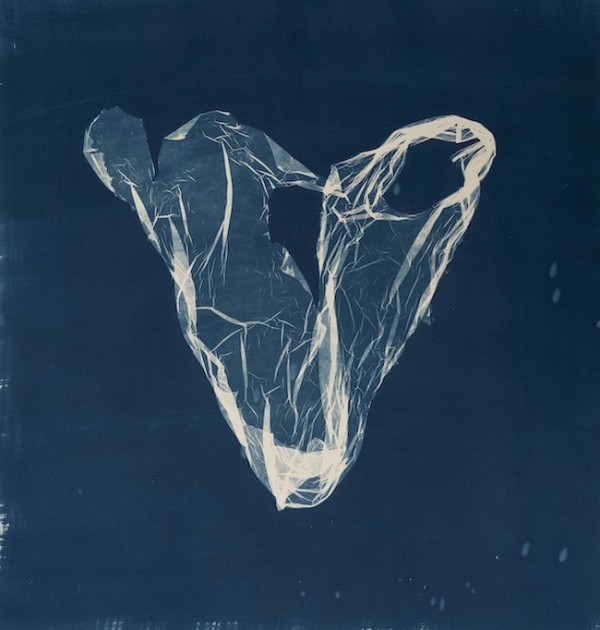
Suzette Bousema, Future Relics 40, 2025. © Suzette Bousema. The image is part of the current exhibit, 'Awakening in Blue: An Ode to Cyanotype, which runs until June 7th.
"We are proud to hold a collection of over 6.5 million photographic objects, making it one of the largest museum collections of photography in the world. We work across all areas of photography, including collecting, scholarship, conservation and restoration, exhibition making and education, to provide a comprehensive overview for the world of Dutch photography of all periods. The museum occupies a key position photography from the Netherlands, the medium having been accepted and experimented with from its very earliest moments as an art form and a means of capturing society. After the Second World War, a socially engaged style developed that became internationally influential, while photographers of our time such as Rineke Dijkstra, Viviane Sassen and Erwin Olaf explore new artistic directions. Some of the works we hold, like the prints by Werner Mantz, Violette Cornelius, Sanne Sannes, Augusta Curielm Ato Kandó, Ed van der Elsken and Peter Martens are amongst the best photographs made in the Netherlands.
Are there gaps in the collection?
"The collection is huge and it contains photographs of just about every possible subject, but not everything is described in full, and there are rolls of negatives that still haven't been digitized. That work is ongoing. As for a more inclusive view on the history of photography and the history of the Netherlands, I think women photographers have been researched for quite a long time. I don't even want to call it inclusive photography, because the term is ridiculous. There are gaps when it comes to photographers from what were the Dutch colonies, as well photographers from the immigrant communities in the Netherlands. Such work, as is the work of all amateurs, is difficult to find, and we have to be active on that front."
You became Head of Collections in 2008. How has the collections grown under your tenure?
"It grew quite rapidly in the first few years. A big part of our collection comes from professional, well-known photographers, who decided to bring their archives to us to secure their legacy. The collection grew and grew, and we realized that we had to come up with an action plan, a major project in order to describe the complete collection in a basic form, and also to digitize it. There was a huge backlog, and we simply didn't have the staff to do all that work, as there were millions of objects. Thankfully, the Ministry of Culture helped out and gave us an extra subsidy, which pleased us, of course. But they also gave us strict instructions: "You mustn't start building up a new backlog."
How did you deal with that?
"It meant we had to change our acquisition policy. One of the biggest archives we have consists of more than half a million objects by a single photographer. That's 1/12 of the entire collection. We get approached by a lot of press and documentary photographers to take on their archives, many who were shooting in the '60s, '70s and '80s. Instead of taking on the archives of five press photographers who were active during the same period, we would take on one. In other cases, rather than taking on their whole archives, we decided to ask them to make a selection of images. For example, a selection could be made around a book or some specific project. It's different with art photographers. An art photographer who has a very limited amount of four by five-inch negatives will be looked at differently from a press photographer with 500,000 photographs."
How does the selection process work?
"We have installed an advisory board to help decide which archives should be part of the museum and which should not. This prevents us from accepting more archives than we can handle, and it has worked well.
Keeping in mind the open aspect of the museum, is the collection now more open in the sense that people can stop by and ask to see specific photographs?
"As for showing individual works, we will do it for photographers, researchers, writers, and others who are working on something specific. We have done it for a long time and will continue to do so. But it's not an option to have 100,000 people turn up to look at physical objects. We are simply not geared for that. We will help, depending on the request, but if asked by someone who requests to see all the physical images on a specific subject, we simply can't do that. The research would take months. I would say that the collection is more viewable in the new museum. Our Gallery of Honor has been changed. We have added a beautiful timeline that includes cameras because that was something that the public missed out on a little bit in our old building. There's also more video material, for example, to explain how a camera functions. There will be more photography from the collection being shown, and you can see how the archive is kept, and we have a display of some 50 physical objects from the collection, which will be changed every three months. In addition, we are putting more and more material on our website, now more than 740,000 records with 350,00 images, giving further access to the collection."
In other countries, institutions are mindful of what the other institutions acquire, so as not to double up. Do you have a dialog with your colleagues?
"Yes, we do. Rijksmuseum is a very big player in the Netherlands, but there are photography collections in many other archives and museums, at least around ten with a real focus on the medium, I would say, including the Stedelijk Museum. We all get together for a talk once a year, and we also keep a running dialog as to what we are acquiring. One of the main differences from most of the other institutions is that we are geared towards Dutch photography. And we have a different focus. Erwin Olaf is a good example. Rijksmuseum will collect a broad selection of his whole oeuvre from when he started until he passed away; whereas we might pick one project or two projects that we think are representative. Another example is Rineke Dijkstra. At least ten institutions in the Netherlands have works by her, so we would choose a specific subject or an image which has not been collected by the other institutions."
What challenges does your museum face at this stage, and what challenges do you anticipate down the line?
"We have our beautiful cold storage where we keep the material at four degrees Celsius. For the time being, we have enough space to grow the collection, but we wouldn't be able to add another six and a half million objects. It means we have to change our way of collecting. We also have to make decisions as to what to digitize as acetate film is fragile. It's a battle against time. Acetate will last a few hundred years in the right conditions, but not forever. Digital photography is another challenge. How do you cope with amateur photography, which is now so huge. How do you collect it? Amateur photography used to be snapshots collected in albums, but that's not how amateur photography is done and kept now. It's made with smart phones and uploaded to the web. And how long will those platforms exist?"
Keeping in mind just how much digital photography is produced, how do you decide what collect?
"It's quite an issue. While we are almost ready to receive that kind of work, we're not totally up to speed. It plays a big role for professionals and amateurs alike, on Instagram and other kinds of platforms. Sometimes the photos themselves are not the most interesting thing, but the context around them and reactions to them often are; and you will want to store all that context information with the image. It's a complicated field and we shouldn't ignore it, but our institution used to be totally geared towards analog photography, and now we have to make the change. We cannot stop collecting analog photography, because that's still a big part of what we do. We have the archives and we have the acquisition scheme to buy photography as art, for instance, by photography from younger photographers who have subjects which we might miss in the archives, like queer photography or other stories to tell."
On the subject of digital media. How far do you stretch it? To moving images?
"During the era of analog, there was an easy split between moving images and still pictures. We would do photography, and the Eye Filmmuseum in Amsterdam would do moving images. If we had 16-millimeter films in the archives, we would either give it to them, or have them keep it for us, because they were equipped to do that. With digital, that's changing because photography and film are moving much closer. There are many artists now who do both film and photography, in some cases with the same camera. I don't think we've solved that problem. We're not scared of also doing moving images, but it's a completely different field. How do you show it? How do you put it on a website? I think we will remain focused on still images, while keeping tabs on moving images and other art forms. Of course, digital photography can be shown as a physical print on a wall. That's easy for us, but if digital photography can also be shown as an immersive installation, then in that case, you need an architectural way of presenting it."
Let's return to the analog world. The museum now has two darkrooms.
"We used to have a professional darkroom where photographers could make prints, be it for exhibitions or for sales; but we never had a darkroom that was accessible to the public, so we decided to create one in the new building. The new darkroom is divided into two spaces. There's a darkroom with five enlargers where we can receive groups who can experiment with analog photography. The darkroom will be accessible at set times, in an educational context, so there's no real public accessibility, at least not in the beginning. In addition, there's a professional darkroom, used by our own staff and other professionals."
It's timely, analog photography is booming.
"It is! And it's important to show young people just how complicated the process of creating photographs was—exposing a negative, developing and printing—and that there was manipulation long before Photoshop came along. There is a generational shift going on. I was an amateur photographer myself, and I was happy to switch from analog to digital, as it made the process much easier; but the generation of my children has grown up with their smart phones. They take great photographs with their phones, but they also find it boring. Just press a button and there's the image. They're fascinated by analog photography, experiencing the magic of seeing the images emerge in the darkroom. And they love the surprises, even the mistakes, where things don't go as planned. Letting go and just seeing what the camera does. Experiencing the wonders that analog photography can provide."
Rotterdam in Focus: The City in Photographs 1843 – Now runs until May 24, 2026.
The book of the same name is published by nai010.
Awakening in Blue: An Ode to Cyanotype runs until June 7, 2026.
Michael Diemar is editor-in-chief of The Classic, a print and digital magazine about classic photography. In August 2025, he cofounded Vintage Photo Fairs Europe, an organization focused on promoting independent tabletop fairs in Europe and spreading knowledge about classic photography in general. He is a long-time writer about the photography scene, writing extensively for several Scandinavian photography publications, as well as for the E-Photo Newsletter and I Photo Central.


Share This