

The Other Photography Fair Launched at Nearby Hilton London Olympia
Book Review: Documenting Fashion by Rebecca Arnold
Todd Webb Archive Acquired by MUUS Collection
Over 150 Photographs Recently Added to I Photo Central Website: Over 4,500 Photographs Now for Sale
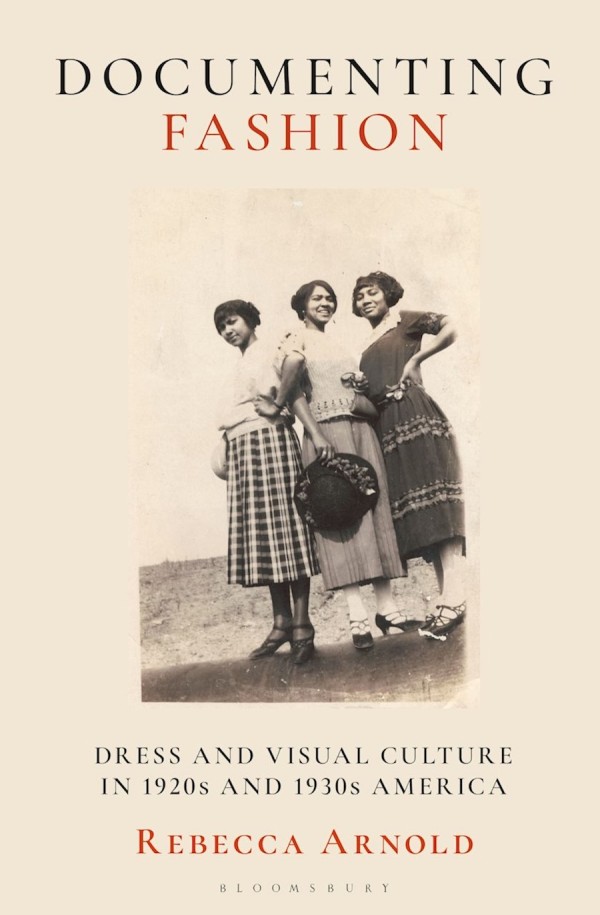
I'm no doubt paraphrasing, but Jean Cocteau once stated, "One must forgive fashion its sins and trespasses for it dies so very young." Fashion, and by extension, fashion photography has historically been seen as superficial and frivolous though anyone who's prepared to dig deeper, will discover a far more complex story. Even so, books on the subject tend to be lavish affairs, with the focus on the purely visual.
Documenting Fashion – Dress and Visual Culture in 1920s and 1930s America by Rebecca Arnold (Published by Bloomsbury Visuals Arts) is a rare exception. Though there are numerous images in the book, by Edward Steichen, George Hurrell, Clarence H. White, Man Ray and others, this isn't a picture book. Arnold is a fashion historian and has previously held posts at the Royal College of Art and the Courtauld Institute. Her previous books include Fashion, Desire and Anxiety: Image and Morality in the Twentieth Century (2001) and The American Look: Fashion and the Image of Women in 1930's and 1940's New York (2009).
Where other books focus on the designers, the photographers, and sometimes the models, Arnold's book tells the much more complex story of fashion, the business, media, and the consumers. It comprises thematic case studies that build to create a discussion of fashion as embodied experience, underlining that all viewers of fashion are also wearers, consuming magazines and other types of images, just as they purchase clothing and accessories.
Photography of course, played an important part in the growth of the industry. The revolution started by Kodak, created scores of amateur photographers, and in 1927, Siegfried Kracauer, the German writer and sociologist, noted in an essay, "The world itself has taken on a 'photographic face', it can be photographed because it strives to be absorbed into the spatial continuum which yields to snapshots."
Arnold notes that Cecil Beaton in 1933 commented on the huge number of amateur photographers that had emerged during the previous decade that "inundated" Vogue's editor with requests to work for the magazine. Vogue's switch to photography from fashion illustration was then fairly recent, a result of Condé Nast's decision to hire Dr M. F. Agha as art director.
Fashion, for those who care to look, holds up a mirror to society, and Arnold describes how fashion responded to the interwar period's trauma (post-WWI, 1918 flu), exploring the rise of the "little black dress" and the inclusion of darker, more melancholic themes in fashion plates. It is a complex story and Arnold takes in department stores, shop window displays, the growing tourism industry (necessitating suitable holidays clothes) and Hollywood movies. Newspapers, fashion and women's magazines such as Vogue and The Delineator are analyzed alongside examples from Black media, including Abbott's Monthly Magazine and The Afro-American.
One section deals with Black and Tan, a 19-minute film from 1929, written and directed by Dudley Murphy, set during the Harlem Renaissance, the first film to feature Duke Ellington and His Orchestra. Fredi Washington played Ellington's wife in the film. Later in her life, she stated in an interview, "I felt you do not have to be white to be good. But to pass, for economic or other advantages, would have meant that I swallowed, whole hog, the idea of Black inferiority. I did not think up this system, and I was not responsible for how I looked. So I said to myself: I'm a Black woman and I'm proud of it."
A few years prior, Dudley Murphy had collaborated with Fernand Léger on a film called Ballet Mécanique, regarded as an avant-grade film classic, with music by George Antheil. Other contributors included Man Ray and Ezra Pound. Arnold notes, "Ironically, many white American artists, including Murphy became immersed in jazz while in France" and "these avant-garde European influences, themselves inspired in part by African and Black American art and music, what has been called the Aframericanization of popular culture, were then returned to the United States. They were deployed to reimagine Harlem's nightclub scene and rupture the physical restrictions imposed by filming, by using the camera to create imagery of cosmopolitan modernity and transnational hybridity."
Michael Diemar is editor-in-chief of The Classic, a print and digital magazine about classic photography. In August 2025, he cofounded Vintage Photo Fairs Europe, an organization focused on promoting independent tabletop fairs in Europe and spreading knowledge about classic photography in general. He is a long-time writer about the photography scene, writing extensively for several Scandinavian photography publications, as well as for the E-Photo Newsletter and I Photo Central.
The Other Photography Fair Launched at Nearby Hilton London Olympia
Book Review: Documenting Fashion by Rebecca Arnold
Todd Webb Archive Acquired by MUUS Collection
Over 150 Photographs Recently Added to I Photo Central Website: Over 4,500 Photographs Now for Sale


Share This